|
|||||||||
| Palestine | |||||||||
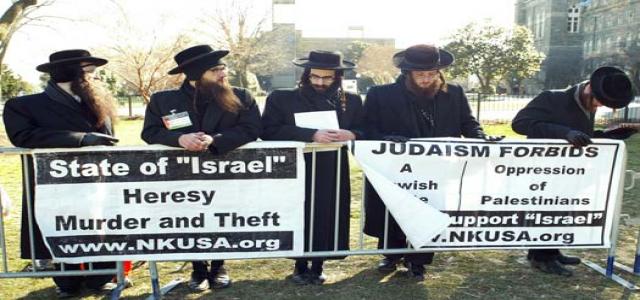
Jews, Judaism and Jewishness
Gilad Atzmon explains why it is essential for the pro-Palestinian movement “freely to explore the true nature of the ideology that drives the Jewish state and Jewish politics”, and to acknowledge that the Jewish ideological, political and cultural discourse is “foreign to universalism and to the ideas of true equality”.
|
|||||||||
| Sunday, December 19,2010 20:13 | |||||||||
|
|||||||||
|
Since Israel defines itself as the “Jewish state”, we are entitled to consider what the word “Jewish” stands for. 1. Jews – the people During my study of Zionism, Jewish politics, identity politics and culture, I have managed to avoid embroiling myself in the complexity involved with the first category – I do not deal with Jews as a race or ethnic group. I also generally avoid dealing with Judaism (the religion). In fact, I am the first to admit that the only Jewish collective to support the Palestinians comprises groups that exist within the Torah Jews. That such groups support Palestinian self-determination and autonomy is proof enough that aspects of religious Judaism can be interpreted as emphasizing ethical precepts.
However, I am very critical of what I view as “Jewish ideology”, and I am also critical of what I consider to be “Jewish identity politics”. “Jewish ideology” is basically an amalgam of racially-orientated exclusivist arguments. It is fuelled by assumptions about ethnocentric supremacy, and ideas such as “chosenness”. Being a tribal setting then, Jewish ideology defies equality. It also opposes universalism. The followers of that ideology tend to believe that they are somewhat different and even better (chosen) than non Jews. And much Jewish political activity is a formulation and an expression of a tribally exclusive club that demands a “Jews only” entry card. It is important to note that Jewish ideology and Zionism are not entirely the same – in fact, Zionism should be seen as just one manifestation of Jewish ideology. Though Israel is the fruit of the Zionist project, it is vital to realize that Zionism does not drive Israeli politics or ideology. In fact, Zionism is largely a Diaspora Jewish discourse. While early Zionism presented itself as a promise to “resolve the galut” (Diaspora) by “transforming” the Diaspora Jew into an “authentic, civilized” human being, it is important to remember that the last few generations of Israelis have been born in Zion (Palestine) and are, therefore, not entirely shaped by Zionist ideologies. From a Zionist perspective, the modern Israeli is a “post-revolutionary” subject. And, indeed, I myself, among millions of other Israelis, joined the Israeli army because we were Jews – not because we were Zionists.
Israelis do, however, follow what I define as Jewish ideology – they practise and perform a number of different measures that are there to maintain Jewish exclusivity on the land. When 94 per cent of Israeli Jews supported the Israeli army’s murderous tactics against Gazans during Operation Cast Lead, it wasn’t Zionism that motivated them. It was the total lack of empathy with other human beings. It was blindness towards others. It was supremacy and chauvinism. In other words, it was the ugliest homicidal manifestation of their chosenness. Source: Redress Information & Analysis (http://www.redress.cc). Material published on Redress may be republished with full attribution to Redress Information & Analysis (http://www.redress.cc) |
|||||||||
|
tags: Jews / Zionism / Israeli Army / Gaza / Gaza Siege / Blockade / Anti-Siege / Gilad Atzmon / Judaism / Jewishness / Jewish Ideology /
Posted in Palestine |
|||||||||
|
|||||||||
|
|
|||||||||
| Related Articles | |||||||||
|
|
 Back to Homepage


 Facebook
  Digg
Digg  Yahoo
Yahoo  Del.icio.us
  reddit
  StumbleUpon
  Mixx
Mixx  Google


Twitter
Facebook
Most Viewed
Join Our Maillist
Video


|
© The Muslim Brotherhood All copyright and re-transport from the site of any material are allowed as long as the source mentioned |
